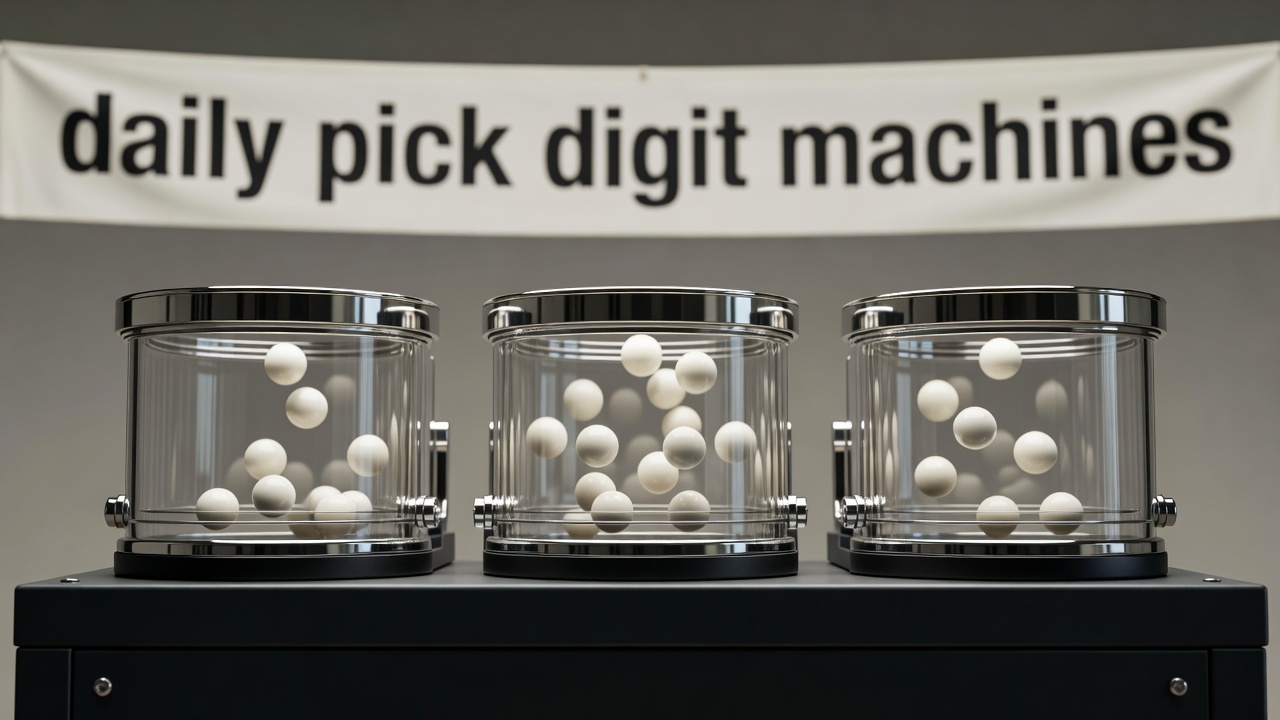
The format spec
A daily pick game draws a short string of digits, typically three or four, each from 0 to 9. The player writes down a string of the same length and chooses how it should be judged. Most US state lotteries run at least one game of this kind under names such as Pick 3, Daily 3, Cash 3, Play 3 or Pick 4, and many hold a midday and an evening draw every day.
| Parameter | Typical setting |
|---|---|
| Places | 3 or 4 (5-place versions exist) |
| Values per place | 0–9, drawn independently |
| Possible results | 1,000 for three places; 10,000 for four |
| Play types | Straight, box, straight/box, combo, pair plays |
| Prize basis | Mostly fixed amounts per unit staked; some states pay shares |
| Schedule | Daily, often twice a day |
Why digits behave differently from a pool
In lotto, a ball that has been drawn is out of the drum, so a set of six can never contain the same number twice. Digit games draw each place separately, either from its own machine or from a set of ten balls that is reset between places. Repeats are therefore normal. The result 4-4-1 is exactly as likely as 4-9-1, and 0-0-0 is exactly as likely as either.
Because each place has ten equal outcomes, the count of results is simply ten multiplied by itself once per place: 10 × 10 × 10 for three places. There is no "choose" arithmetic and no bonus ball. That simplicity is the format's main appeal, and it is why prize charts can promise fixed amounts without much risk of surprise.
Order, however, becomes important. In lotto, order never matters. In a digit game the player decides whether it should, and that decision sets both the chance of winning and the size of the prize.
Play types and their odds
A straight play wins only on an exact match in order. A box play wins on the same digits in any order. How many orders exist depends on whether your digits repeat, which is why box plays are described as "6-way", "3-way" and so on.
| Game | Play | Example | Winning results | Odds |
|---|---|---|---|---|
| 3-place | Straight | 1-2-3 | 1 of 1,000 | 1 in 1,000 |
| 3-place | 6-way box | 1-2-3 | 6 of 1,000 | 1 in 167 |
| 3-place | 3-way box | 1-1-3 | 3 of 1,000 | 1 in 333 |
| 4-place | Straight | 1-2-3-4 | 1 of 10,000 | 1 in 10,000 |
| 4-place | 24-way box | 1-2-3-4 | 24 of 10,000 | 1 in 417 |
| 4-place | 12-way box | 1-1-2-3 | 12 of 10,000 | 1 in 833 |
| 4-place | 6-way box | 1-1-2-2 | 6 of 10,000 | 1 in 1,667 |
| 4-place | 4-way box | 1-1-1-2 | 4 of 10,000 | 1 in 2,500 |
Two other plays are common. A straight/box play splits the stake in half, one half straight and one half box, so it pays more if the order is exact. A combo play buys every straight arrangement of your digits as separate plays and costs a multiple of the base stake. Pair plays (front pair, back pair) judge only two of the places.
How fixed prize charts are set
Most digit games publish a prize chart: a fixed amount for each play type at each stake level. The amount is always below the true odds, and the gap is how the game funds its beneficiaries and costs. In many US states, for example, a $1 straight three-place play pays a fixed $500 against true odds of 1 in 1,000, which means half of the money staked on straight plays is returned on average. Box prizes are scaled down in proportion to the extra arrangements they cover.
A minority of lotteries use shared prizes instead. California's Daily 3 and Daily 4, for instance, are paid on a pari-mutuel basis, so the amount for a straight win depends on sales and the number of winners. Always check which model a given game uses; the play types may look identical while the payout logic is not.
Liability limits and sold-out numbers
Fixed prizes expose an operator to risk. If thousands of people stake on the same popular string, such as a date in the news, and it is drawn, the operator owes every one of them the full fixed amount. To manage this, many lotteries set a liability limit: once total stakes on a particular number reach a threshold, the terminals stop accepting further plays on it for that draw. Players sometimes describe such numbers as "sold out".
A liability limit says nothing about whether that number is more or less likely to be drawn. It only reflects how many people have already backed it.
This panel describes rules and arithmetic for understanding only. Frequent draws can make spending add up quickly; set limits and treat any play as paid entertainment. Players must be adults under local law.
Close relatives of the digit format
Some lotteries add an extra digit, often branded as a "Fireball" or similar, which can be substituted for one of the drawn digits to create extra winning combinations at extra cost. Five-place versions extend the format to 100,000 possible results. Keno, run by many lotteries every few minutes, is a different structure (players choose a few numbers from 1–80 and twenty are drawn), but it shares the daily games' emphasis on fixed prize charts and frequent draws.
Terms used in digit-game rules
- Straight
- Exact digits in exact order.
- Box
- Exact digits in any order; named by the number of arrangements covered.
- Straight/box
- A play split between the two, paying a larger prize for exact order.
- Combo
- Every straight arrangement of the chosen digits, bought as separate plays.
- Liability limit
- A cap on total stakes accepted on one number for one draw.
- Draw period
- Midday or evening, printed on the ticket; each is a separate game.